
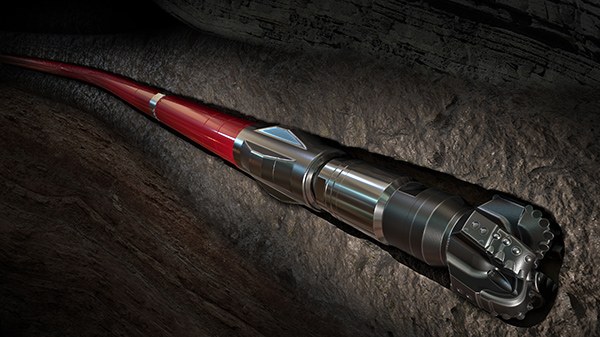
Choosing between a rotary steerable system and a mud motor is not a philosophical debate. It is a dollars-per-foot, NPT-per-well, spud-to-TD decision that directly impacts your well economics. Across 134 wells and more than 1,974,067 feet drilled in the Permian Basin, Delaware Basin, and South Texas, Specialized Energy Services has run both tool types in nearly every formation and wellbore geometry operators encounter in these plays. This comparison draws on that field data, published research, and real performance metrics to help you make the right BHA selection for your next well.
How Rotary Steerable Systems and Mud Motors Actually Work
Mud Motor Fundamentals
A positive displacement motor (PDM), commonly called a mud motor, converts hydraulic energy from drilling fluid into mechanical rotation at the bit. Directional control comes from orienting the bent housing in slide mode, where the drillstring does not rotate and the motor drives the bit to build, drop, or turn the wellbore. In rotary mode, the entire string rotates and the well holds its trajectory. This slide/rotate cycle is the defining operational characteristic of motor drilling and the root cause of several performance limitations.
Rotary Steerable System Fundamentals
An RSS provides continuous directional control while the entire drillstring rotates at all times. Closed-loop steering, either through push-the-bit or point-the-bit mechanisms, allows real-time trajectory adjustments without stopping rotation. Systems like the PowerDrive Orbit G2 and iCruise deliver precise wellbore placement while maintaining full drillstring rotation throughout every foot of the lateral. As defined by the ScienceDirect engineering reference, RSS technology provides accurate directional control through closed-loop steering, enabling higher rates of penetration, smoother boreholes, and extended-reach capability.
Rate of Penetration: Where the Time Savings Live
ROP is the single largest lever on your spud-to-TD timeline, and this is where the performance gap between RSS and mud motors becomes measurable.
Mud motors require slide mode to make directional changes. During slide, the drillstring is static against the wellbore wall, which increases friction, reduces weight transfer to the bit, and drops ROP significantly. Research published in the MDPI open-access journal Processes confirms that RSS outperforms conventional mud motors in penetration rate and borehole quality, with empirical studies showing ROP improvements of up to 400% over motors in specific conditions.
In our field operations, the ROP advantage of RSS shows up most clearly in extended laterals. Specialized Energy Services posted a fastest well of 2.11 days spud to TD in Dimmit County and 4.13 days in Lea County, New Mexico. Those results required sustained high ROP through entire curve and lateral sections without the stop-start penalty of slide mode.
Actionable ROP Guidance
- Track your slide-to-rotate ratio on motor runs. If you are sliding more than 30% of the lateral, the cumulative ROP penalty likely justifies RSS.
- Compare connection-to-connection ROP, not just instantaneous ROP. Motors look fast in rotary mode but lose time on every slide sequence.
- In formations with high abrasiveness (Wolfcamp, Bone Spring), sustained rotation with RSS reduces bit wear and maintains ROP consistency across the lateral.
Borehole Quality and Tortuosity: The Hidden Cost Driver
Slide mode produces a characteristic sinusoidal wellbore profile. Every transition between slide and rotate leaves a ledge or micro-dogleg in the borehole wall. This tortuosity creates several downstream problems that rarely appear on the drilling AFE but show up in completion costs and long-term production.
What Tortuosity Costs You
- Increased torque and drag: A tortuous wellbore increases friction along the entire drillstring, limiting lateral length and increasing the risk of stuck pipe. Research compiled through the Society of Petroleum Engineers (SPE) consistently documents that RSS technology minimizes torque, drag, and stuck pipe incidents compared to motor-drilled wells.
- Compromised casing runs: Micro-doglegs from slide/rotate transitions can cause casing hang-ups, requiring additional reaming trips that add NPT.
- Completion efficiency: A smoother wellbore improves plug-and-perf operations and stage isolation. Operators in the Delaware Basin running 10,000-foot-plus laterals consistently report fewer completion issues in RSS-drilled wells.
- Hole cleaning: As noted in published motor vs. RSS comparisons, mud motors in slide mode offer poor and inconsistent hole cleaning, which leads to cutting bed buildup, pack-offs, and additional circulation time.
Specialized Energy Services addresses borehole quality through a combination of RSS technology and live geosteering. Our well planning team models tortuosity targets before spud, and our geosteering engineers monitor dogleg severity in real time to keep the wellbore within acceptable limits throughout the run.
Tool Reliability and NPT Reduction
Tool reliability is not a talking point. It is a measurable cost input. Every tool failure triggers a trip, and every trip costs you 8 to 14 hours depending on depth. Across our fleet, Specialized Energy Services maintains a 98.97% tool reliability rate over 134 wells. That number covers our RSS deployments (PowerDrive Orbit G2, iCruise), high-torque downhole motors, and GT-MWD systems.
When Motors Carry Higher NPT Risk
Mud motors have more moving parts subject to wear in the power section. Elastomer degradation in high-temperature formations (common in the deeper Wolfcamp and parts of South Texas) can shorten motor life and trigger mid-lateral trips. RSS units, while more complex, are designed for longer run life in continuous rotation and generally deliver lower NPT per lateral foot in extended-reach applications.
When Motors Win on Reliability Economics
In shorter, less complex wells (single curve, limited lateral length), the simplicity and lower daily cost of a mud motor can outweigh the NPT risk. The U.S. Energy Information Administration (EIA) reports on Permian Basin drilling activity confirm that average lateral lengths continue to increase, which shifts the reliability calculus further toward RSS for most new development programs. However, operators drilling shorter wells or infill laterals in well-understood formations may find that a high-performance motor paired with quality MWD delivers the best cost-per-foot outcome.
Cost-Benefit Framework: Choosing the Right Tool for Your Well
Rather than defaulting to one system for every well, operators should evaluate tool selection against three primary variables.
1. Wellbore Geometry and Lateral Length
Wells with extended laterals (7,500 feet and beyond) and complex 3D trajectories favor RSS. The continuous rotation eliminates slide-related NPT and maintains consistent ROP across the full lateral. For shorter laterals with simple build sections, a motor often delivers acceptable performance at a lower daily tool cost.
2. Formation Characteristics
In interbedded formations common across the Permian and Delaware basins, frequent directional corrections are needed to stay in zone. RSS handles these corrections in real time without sacrificing ROP. Motors require repeated slide sequences that slow progress and can create wellbore quality issues. Our AI Driller analytics platform monitors formation tendencies in real time and provides the data needed to optimize either system.
3. Total Well Cost, Not Daily Tool Cost
A mud motor may save you on daily tool rental, but if it adds 1.5 days of drilling time through slide mode ROP reduction and an additional trip for a worn power section, the total well cost often exceeds an RSS run. We recommend operators model total cost per foot, including trip time, completion impact, and production uplift from better wellbore quality, rather than comparing daily BHA rates.
Practical Decision Matrix
- Use RSS when lateral length exceeds 7,500 feet, when the well has a complex 3D trajectory, when formation interbedding requires frequent steering, or when tortuosity limits on completion design are tight.
- Use a high-performance motor when the lateral is under 5,000 feet, when the build section is simple and predictable, when the formation is uniform and requires minimal directional corrections, or when rig specifications limit BHA options.
- Consider a hybrid approach (motor-assisted RSS or motor in the curve with RSS in the lateral) when wellbore geometry includes a high build rate curve followed by a long lateral requiring sustained ROP.
Real-World Performance from 134 Wells and Counting
Specialized Energy Services does not recommend tools we have not run ourselves. Our track record of 1,974,067 feet drilled across the Permian Basin, Delaware Basin, and South Texas gives us formation-specific data on both RSS and motor performance. Our fastest wells, 2.11 days in Dimmit County and 4.13 days in Lea County, were planned and executed using optimized BHA selection, GT-MWD, live geosteering, and AI Driller real-time analytics. Every well in our database informs the next one.
If you are planning wells in the Permian, Delaware, or South Texas and want to evaluate whether RSS, a high-torque motor, or a hybrid approach delivers the best cost-per-foot outcome for your specific wellbore geometry and formation, contact Specialized Energy Services for a well planning consultation backed by real field data.
What is the ROP advantage of RSS over mud motors in extended laterals?
RSS eliminates the slide/rotate cycle that drops ROP during directional changes. Research shows ROP improvements up to 400% over motors in specific conditions, and the advantage compounds in extended laterals where cumulative slide time significantly increases total drilling days.
At what lateral length should operators switch from a mud motor to a rotary steerable system?
Wells with laterals exceeding 7,500 feet generally favor RSS due to sustained ROP, lower tortuosity, and reduced NPT from fewer trips. Motors can deliver acceptable cost-per-foot performance in laterals under 5,000 feet with simple build sections and uniform formations.
How does slide mode tortuosity from mud motors affect completion costs?
Slide/rotate transitions create micro-doglegs and a sinusoidal wellbore profile that increases torque and drag, causes casing hang-ups requiring reaming trips, and reduces plug-and-perf efficiency. Operators running 10,000 foot plus laterals in the Delaware Basin consistently report fewer completion issues in RSS drilled wells.
When does a mud motor make more economic sense than RSS in the Permian Basin?
Motors can win on total well cost for shorter laterals under 5,000 feet, simple single-curve build sections, uniform formations needing minimal steering corrections, or when rig specifications limit BHA options. A high-performance motor paired with quality MWD can deliver the best cost-per-foot outcome in these scenarios.