Non-productive time is the most expensive line item on any drilling AFE that delivers zero return. In the Permian Basin alone, operators lose millions of dollars annually to stuck pipe events, unexpected tool failures, and torque/drag issues that could have been detected hours before they became full-blown NPT events. The difference between a 4.13-day well and a 6-day well often comes down to one thing: how fast your team identifies and responds to downhole inefficiencies. AI drilling analytics now make it possible to detect those inefficiencies in real time, correct course before problems compound, and shave critical hours off every well in a pad program. At Specialized Energy Services, our AI Driller platform has helped us drill 1,974,067 feet across 134 wells at 98.97% tool reliability, including the fastest wells posted in Dimmit County (2.11 days) and Lea County, New Mexico (4.13 days). Here is exactly how real-time downhole analytics translate to faster, cleaner wells.
What AI Drilling Analytics Actually Do Downhole
AI drilling analytics is not a buzzword. It is a system that continuously ingests downhole sensor data from MWD tools, rotary steerable systems, and surface parameters, then applies machine learning models to identify patterns that precede costly drilling events. The U.S. Department of Energy has identified real-time data analytics as a critical pathway to reducing drilling costs and improving wellbore quality in unconventional plays (U.S. DOE Oil and Gas Research).
In practical terms, AI drilling analytics platforms process thousands of data points per second, including weight on bit, differential pressure, torque, RPM, toolface orientation, gamma ray readings, and vibration signatures. The system compares live conditions against offset well data and physics-based models to flag anomalies before they escalate.
From Reactive to Predictive Drilling
Traditional drilling operations rely on human interpretation of surface gauges and periodic MWD surveys. By the time a drilling engineer spots a trend on a morning report, the well may have already accumulated hours of suboptimal ROP or, worse, a stuck pipe event. AI drilling analytics shift the decision loop from reactive to predictive. The system identifies early indicators of problems such as increasing torque trends, abnormal equivalent circulating density, or gradual bit degradation and alerts the team in real time.
A peer-reviewed study published in the Journal of Petroleum Technology by the Society of Petroleum Engineers confirmed that AI-enabled drilling optimization reduced NPT by 20 to 30 percent across multi-well programs by detecting wellbore instability and pressure anomalies before they caused operational shutdowns (SPE Journal of Petroleum Technology).
How AI Driller Reduces NPT in Directional Wells
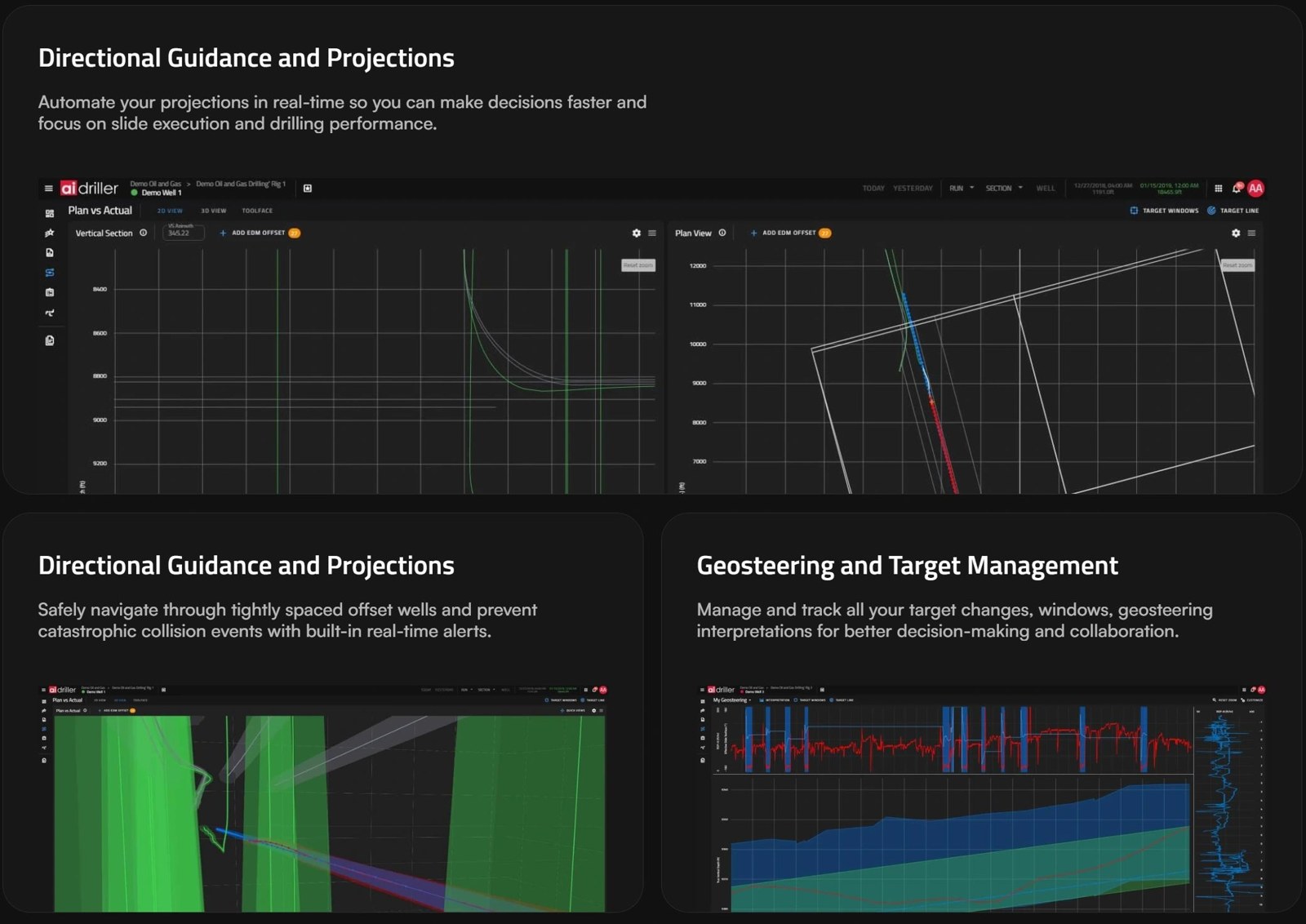
Our AI Driller platform is built specifically for directional drilling operations in the Permian Basin, Delaware Basin, and South Texas. It integrates directly with our GT-MWD measurement while drilling systems and rotary steerable tools (PowerDrive Orbit G2, iCruise) to provide a continuous, closed-loop analytics feed from spud to TD.
Torque and Drag Prediction
Excessive torque and drag are among the leading causes of NPT in extended-reach laterals and complex directional wells. AI Driller continuously compares measured torque and drag values against predicted models calibrated to the specific wellbore geometry, mud weight, and formation properties. When the system detects divergence between predicted and actual values, it flags the anomaly immediately. This early detection allows the directional driller and company man to adjust parameters, circulate, or modify the well plan before a stuck pipe event occurs.
In practice, this means catching a tortuosity buildup in the curve section at 8,000 feet measured depth rather than discovering it at 14,000 feet when the BHA will no longer slide. The difference can be 12 to 18 hours of NPT avoided on a single run.
Bit and Tool Degradation Monitoring
AI Driller tracks vibration signatures, mechanical specific energy (MSE), and ROP trends to identify bit wear patterns in real time. Instead of pulling a bit on a scheduled footage interval, operators can run the bit to its actual performance limit, or pull it before catastrophic failure costs a fishing trip. Our 98.97% tool reliability rate reflects not just equipment quality but also the analytics layer that prevents tools from being pushed past their operational envelope.
Automated Parameter Optimization
The platform continuously recommends optimal WOB, RPM, and flow rate combinations based on the formation being drilled. As the BHA transitions from the Bone Spring into the Wolfcamp, or from the Eagle Ford shale into the Austin Chalk, AI Driller recalibrates recommended parameters within seconds. This eliminates the trial-and-error approach that typically costs 30 to 60 minutes of suboptimal ROP at every formation transition.
Real-Time Downhole Data and Faster Spud to TD Times
Cutting spud to TD time is not about drilling recklessly fast. It is about eliminating wasted time, maintaining consistent ROP, and avoiding the events that force a rig to sit idle. The International Association of Drilling Contractors (IADC) has documented that real-time data integration and predictive analytics are among the highest-impact technologies for reducing well construction cycle times (IADC Advanced Rig Technology).
Connection Time Reduction
AI Driller monitors standpipe pressure bleed-down, pump ramp-up profiles, and connection sequencing to identify time savings at every connection. In a 20,000-foot lateral with 400-plus connections, saving even 90 seconds per connection adds up to 10 hours of recovered drilling time. That is often the margin between a record well and an average one.
Geosteering Integration
Our AI Driller platform feeds directly into our live geosteering operations, allowing the geosteering team to see not just where the wellbore is relative to the target zone but also how efficiently the BHA is drilling to stay there. When the system detects that gamma ray values are trending toward a zone boundary, it can recommend a toolface adjustment before the lateral exits the pay zone. This reduces correction runs and keeps the bit in the reservoir, both of which contribute to faster TD times and better well placement.
Pad Drilling Scenarios: The Compounding Effect
AI drilling analytics deliver their greatest value in pad drilling programs where offset well data from each completed well improves the predictive model for the next one. By the third or fourth well on a pad, AI Driller has mapped the formation tendencies, identified the optimal parameters for each interval, and refined its torque/drag models using actual wellbore survey data. This compounding learning effect is how operators achieve consistent well-over-well improvement rather than isolated one-off records.
Our 2.11-day well in Dimmit County and 4.13-day well in Lea County were not anomalies. They were the result of AI-refined drilling programs that improved with every foot drilled on the pad.
Actionable Steps for Operators Evaluating AI Drilling Analytics
If you are an operator or drilling engineer looking to integrate AI drilling analytics into your well programs, here are practical steps to get started:
- Audit your NPT data from the last 10 wells. Categorize events by root cause (stuck pipe, tool failure, wellbore instability, connection time, trips). This tells you where AI analytics will deliver the highest ROI.
- Ensure your MWD and surface data systems can stream in real time. AI analytics platforms require continuous, high-frequency data feeds. Legacy batch-upload systems will not support predictive capabilities. The Energistics WITSML data standard provides a framework for real-time drilling data exchange that supports AI integration.
- Integrate analytics with your directional drilling service provider. AI drilling analytics deliver the most value when the same team controlling the BHA also controls the analytics platform. Disconnected systems create latency between insight and action.
- Start with a pilot pad, not a single well. The compounding learning effect of AI analytics requires multiple wells to demonstrate its full value. A three-to-four well pad program gives the system enough offset data to calibrate its predictive models.
- Demand specific KPIs from your analytics provider. Ask for measurable targets: percentage NPT reduction, ROP improvement by interval, connection time benchmarks, and tool reliability rate. If they cannot commit to measurable outcomes, the platform is not field-proven.
Why AI Drilling Analytics Matter Now
Operators in the Permian Basin, Delaware Basin, and South Texas are drilling longer laterals into tighter spacing with higher expectations for capital efficiency. The margin for error is shrinking. A research report from McKinsey and Company found that AI-driven drilling optimization can reduce overall well construction costs by 10 to 20 percent while simultaneously improving wellbore quality and consistency.
The operators posting the fastest wells and the lowest per-foot costs in these basins are not doing it with brute force. They are doing it with real-time downhole data, predictive analytics, and drilling teams that act on AI-generated insights before problems hit the morning report.
Partner with a Team That Has the Data to Back It Up
Specialized Energy Services has drilled 1,974,067 feet across 134 wells with 98.97% tool reliability. Our AI Driller platform is not a prototype. It is a field-proven system integrated with our rotary steerable systems, high-torque drilling motors, GT-MWD tools, and live geosteering services. Every foot we drill makes the system smarter and your next well faster.
If you are planning a pad program in the Permian, Delaware Basin, or South Texas and want to see how AI drilling analytics can cut your spud to TD time and reduce NPT, contact our team to review your upcoming well plan. We will show you exactly where the time savings are, backed by offset data from the basins where you operate.
How does AI drilling analytics reduce non-productive time in directional wells?
AI drilling analytics continuously ingests downhole sensor data and compares live conditions against offset well models to flag anomalies like increasing torque trends or bit degradation before they cause NPT events. Peer-reviewed SPE research shows AI-enabled drilling optimization reduces NPT by 20 to 30 percent across multi-well programs.
How much time can real-time connection optimization save on a long lateral?
By monitoring standpipe pressure bleed-down, pump ramp-up profiles, and connection sequencing, AI analytics can save roughly 90 seconds per connection. On a 20,000-foot lateral with over 400 connections, that adds up to approximately 10 hours of recovered drilling time.
Why do AI drilling analytics work better on pad drilling programs than single wells?
Each completed well on a pad provides offset data that improves the predictive model for the next well. By the third or fourth well, the system has mapped formation tendencies, optimized parameters for each interval, and refined torque and drag models, creating a compounding learning effect that drives consistent well-over-well improvement.
What data systems are needed to support AI drilling analytics on a rig?
AI analytics platforms require continuous, high-frequency data feeds from MWD tools, rotary steerable systems, and surface sensors. Legacy batch-upload systems will not support predictive capabilities. The Energistics WITSML data standard provides a framework for real-time drilling data exchange compatible with AI integration.